V

V
“Just when you think a book, or ‘text’, can be connected with others to fashion a whole – three makes a trend, as journalists say – you see another connection, and another, and more, and realize that relations really, universally, stop nowhere, as the landscape stretches into the dark.” Cal Revely-Calder, TLS
I.
It was John Milton’s infamous line, "The mind is its own place, and in itself can make a heav'n of hell, a hell of heav'n," that was first to cunningly reinforce Descartes’ Cogito, ergo sum, capturing in blank verse (think unchained) Lucifer’s fallen state of mind. The line emerges from Book 1 of the blind poet’s 1667 epic,Paradise Lost, which, while composed earlier, was delayed by the Great Plague (1665-1666) and the Great Fire of London (1666). Two-hundred and eighty-four years later, Samuel Beckett would publish Molloy (1951), a novel that (composed during the second Great War) is the first book of the Unity, bound beside Malone Dies and The Unnamable. From Descartes’ Devil to Milton’s Satan, and only after the tragic lot of the Romantics, do we finally arrive in the cratered pandemonium of the Modernists wherein liberty and freedom, analogous to Satan’s mind, are beginning to violently collapse inward, driven by the machines of capital that we now know all too well for the bitten fruit upon the slopes of Silicon. Molloy admits, “In my head, there are several windows, that I do know, but perhaps it is always the same one, open variously on the parading universe” (46). Read in 2026, during Trump’s reload of “Make ‘Merica Great Again,” the tragic collapse of Molloy’s mind drifts as the objective correlative for the web of windows that influence, handle, operate and control the metaphysical fragments of our own minds. “The blood drains from my head, the noise of things bursting, merging, avoiding one another, assails me on all sides, my eyes search in vain for two things alike, each pinpoint of skin screams a different message, I drown in the spray of phenomena. It is at the mercy of these sensations, which happily I know to be illusionary, that I live and work” (106). While the revelation could have come from the mind of Molloy, it is the agent Moran who catalogs the symptoms that have engulfed him since being selected by Gaber to track down Molloy. Beckett introduces the agent at the beginning of section two, which strikingly reflects the narrative of Franz Kafka’s unfinished novel The Castle; the flow, however fractal in its own stream of consciousness, is lucid and rigorous before submerging into the depths of the subconscious. What is more? This switch occurs, like a light turning off or on, after Moran suffers a brief exchange with a neighbor, who voices his part: “You look as if you had seen a ghost,” to which Moran replies, “Worse than that, I said, you.” Fast-forwarding to the blockbuster film It, one ought to be horrified by what follows: “I went in, at my back the dutifully hideous smile. I could see him running to his concubine with the news, You know that poor bastard Moran, you should have heard me, I had him [sic] lepping! Couldn’t speak! Took to his heels” (93)! “It” is something then in the wrenched smile and spiteful eyes (the self-same “baleful eyes” and “furious gestures” that in Milton’s Paradise Lost alarm the archangel Uriel) which become the riptide to overwhelm the speaker, dragging Moran’s distinctive flow of consciousness out into (how to put this) a wine-dark sea, where quickly the autonomy of Moran gives to the depths of the same collective thought-form or deep subconscious. The corrupting process, from Michael to Moran, is a contagion, a virus that not only spreads but is determined by mere observation—what once was an autonomous wave of light becomes a corrupted particle, “part” of the lie, as when Moran spreads the neighborly smile of It to his housekeeper: “Tell me, Martha, I said, what is this preparation? She named it. Have I had it before? I said. She assured me I had. I then made a joke which pleased me enormously, I laughed so much I began to hiccup. It was lost on Martha who stared at me dazedly. Tell him to come down, I said at last. What? said Martha. I repeated my phrase” (111). The smile is inenarrable, too intense, extreme, complex to be properly absorbed by the senses. It overtakes the mind’s motherboard, galvanizing the brain’s circuitry into the void of collapse. Milton warns of the machines of the void that generate the fruits of Heaven:
These things, as not to mind from when they grow
Deep underground, materials dark and crude,
Of spiritous and fiery spume, till touched
With Heaven’s ray, and tempered, they shoot forth
So beauteous, opening to the ambient light? (477-78, Book VI)
These devices or as Satan[1] prefers, shouting from his pulpit: “Such implements of mischief,” will dilate and infuriate to “dash / To pieces, and overwhelm whatever stands / Adverse, / that they should fear we have disarmed / The Thunderer of his only dreaded bolt” (488-91, Book VI). The emphasis on the eye—Milton writes, “long and round,” “dilated and infuriated” (484-86, Book VI). Though blind, the Poet is winking at the bolt of the iris that in a blink of an eye absorbs the baleful smile of the Watchers.
Once dilated, one’s autonomy gives over, ripping out into the depths of this collective subconscious, their thoughts and empirical experiences violently collapsing inward towards the center of what might best be described as a personal hell, at which point (like an atomic bomb after implosion) this egregore physically acts out, erupting in rash fits of explosive anger. Shortly before Moran capitulates to the smile of it, the agent envisions himself doing quite the opposite, metamorphosing into Rodin’s The Thinker: “I had the joyful vision of myself far from home, from the familiar faces, from all my sheet-anchors, sitting on a milestone in the dark, my legs crossed, one hand on my thigh, my elbow in that hand, my chin cupped in the other, my eyes fixed on the earth as on a chessboard” (120). However, a page later Beckett reveals Moran with an axe in his yard, doing exactly the opposite: “trembling” and “hacking madly at an old chopping-block that lay there and on which in winter, tranquilly, I split my logs.” The contrast in character matches that of Jekyll and Hyde; Moran confessing during this season of fever that “finally the blade sank into it so deeply that I could not get it out” (121). Undeniably, after the encounter with the neighbor, a presence if not entity has taken over Moran’s domain. Moran reveals so much: “For gluing my eyes to the window-pane I discerned a faint reddish glow which could not have come from the oven […]I’m sorry, but there it[2] is” (118). We have arrived full circle, back to the future of Stephen King’s It.
The influence of this entity darkly parallels that of a shepherd or minister to their flock. After the eruption that leaves Moran’s axe like Excalibur lodged in the stump, we find Moran near midnight stealing off with his son. While Jacques (the son) left to his own campaigns is fully capable of maneuvering through the great schemes of the world, his autonomy appears to be overwhelmed when in the presence of this entity. The father admits so much: “The least outing with him was torture, he lost his way so easily. Yet when alone he seemed to know all the short cuts. When I sent him to the grocers, or to Mrs. Clement’s, or even further afield, on the road to V for grain, he was back in half the time I would have taken for the journey myself, and without having run” (123). Moreover, the father has conditioned the son to “leaving everything to [him],” so that the son would not “heed what he was doing” or “look where he was going,” as if Jacques would go on “mechanically plunged in a kind of dream” (123). At this point the father-son relation convexly mirrors that of Lucky and Ponzo: “I toyed briefly with the idea of attaching him to me by means of a long rope, its two ends tied about our waists.” Moran, under the handle of it, goes even further in the vice of oppression and cruelty, professing that “I did dream of it, for an instant I amused myself dreaming of it, imagining myself in a world less ill contrived and wondering how, having nothing more than a simple chain [think 5G, read wireless], without collar or band or gyves or fetters of any kind, I could chain my son to me in such a way as to prevent him from ever shaking me off again” (124). What is more? The designs of this entity match as if to ignite those of Satan: “Caught up then in the slow tide of the faithful my son was not alone with me. But he was part of that docile herd going yet again to thank God for his goodness and to implore his mercy and forgiveness, and then returning, their souls made easy, to other [my emphasis] gratifications” (123). Comically, though perhaps tragically for some folded into this entity, the cart ends up before the horse. (Descartes’ horse.) By the time Moran emerges from the depths of the egregore’s pipedream, he finds himself bolted and struck by “the image of my son no longer behind me, but before me” (124). Indubitably, the son hath declared, “Satan, get behind me.”
II.
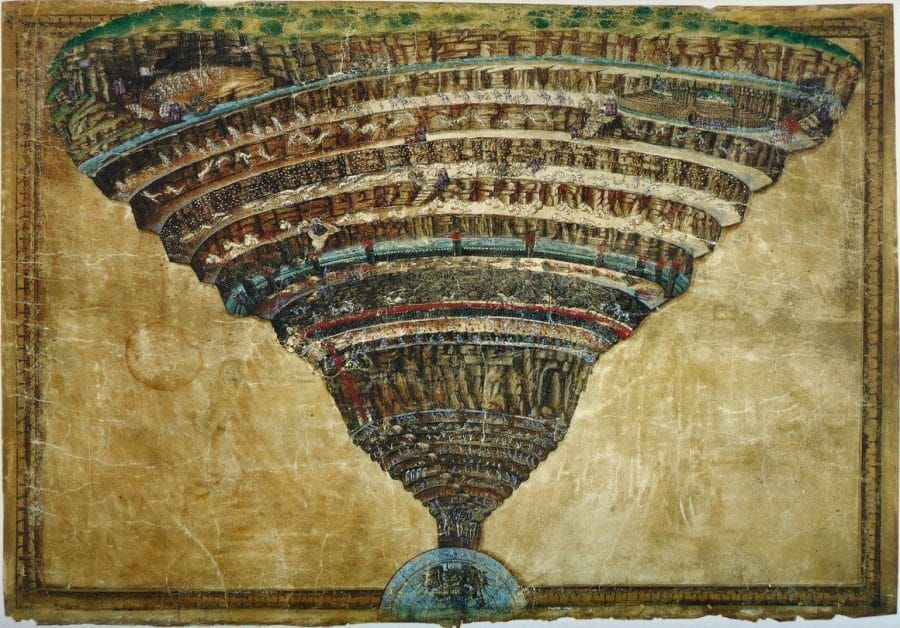
Dante’s Inferno positions Hell as a construct spiraling inward, inverting W.B. Yeats’ more gnostic conception of history as a great gyre of time. Like a Nautilus Shell, both poets speak of one simulation but from opposing ends of the same deception. It is only with The Divine Comedy that we discover Vergil (short for Vergilius) guiding Alighieri through the gates of 0-9, the caveat being the exile’s eagle-eyed journey commences outside S’s silicon glass of time. Thinking of modern-day games—Super Mario in particular—there are always warp pipes and rabbit holes these watchers or watchmakers (read Satan’s elves) can access to dilate and infuriate the masses at any given Ley line or conjunction in time, using machines from what seems the gates of some future. Unfortunately, for these watchmakers, time is a delusion.
Recalling Back to the Future, the horror film Halloween casts not Lucifer but Michael as the dark one, a wicked force that, kindred to Momus, wears a mask to Hyde its true nature. When we get rid of all the babble, uniting Milton’s Paradise Lost with the various lots of other creation cycles, the arch-angel Michael in the Apocalypse is unveiled for the jealous son of the Great Mystery Above—similar to Cain, similar Loki, and perhaps identical to the jealous unnamed son captured in the Parable of the Prodigal Son.
Further, Satan is one of the fallen but until this point was never named. However, tracing the term back through the depths of its Hebrew roots, śāṭān is dispelled for the three marks of "adversary," "accuser," "opponent." What is more? The dark one merely stains the legacy of Lucifer through the babble of mistranslation. While far-fetched, it logically holds that Michael is the Angel who, jealous of Lucifer being the apple held in his Father’s eye, decides a great scheme against the bearer of light, creating sin and, from sin, death to trap his celestial brother in (how to put this) some silly X-Box of Time. From Book II we gain so much, the Portress of Hellgate uttering to the fallen Michael:
Hast thou forgot me, then; and do I seem
Now in thine eye so foul?—once deemed so fair
In Heaven, when at th’ assembly, and in sight
Of all the Seraphim with thee combined
In bold conspiracy against Heaven’s King,
All on a sudden miserable pain
Surprised thee, dim thine eyes and dizzy swum
In darkness, while thy head flames thick and fast
Threw forth, till on the left side opening wide,
Likest to thee in shape and countenance bright,
Then shining heavenly fair, a goddess armed,
Out of thy head I sprung” (746-58, Book II).
The revelation to Michael pollinates the germ concerning how to reverse the arch angel’s own ruin, imparting (as Satan or It or Momus) to first banish mankind from paradise. It is first by trapping Adam and Eve in the gyre of time that the horror show, in which we currently live and breathe, can be projected—the aim being to pin this clown’s crimes upon the prodigal son. In the many cycles of this clown’s pipedream—reflecting the spiraling circles of The Inferno—the truth will, of course, be reversed. Repeatedly, ‘til Sin and Death birth Lucifer at the end of the gyre of time. A pretentious attempt to negate the true account—that being Sin and Death first were spawned from Michael’s own fallen state of mind.
III.
Turning back to Beckett’s Molloy, Moran attends to Sisyphus, stating “But I do not think even Sisyphus is required to scratch himself, or to groan, or to rejoice, as the fashion is now, always at the same appointed places. And it may even be they are not too particular about the route he takes provided it gets him to his destination safely and on time. And perhaps he thinks each journey is the first. This would keep hope alive, would it not, hellish hope” (128). While on the surface the importance may seem trite and frivolous for humankind, the nod to Sisyphus objectively correlates and applies to every individual on this planet. What’s more, one ought to put more weight in the idea of reincarnation, recalling that, after death, Thoth is known to weigh one’s heart upon the scales of Judgement, measuring the nature of his or her or their (hell, even its) own life. Springing back to mind the labs that grow, fine-tune, and supervise machines of Artificial Intelligence—salvaging, recycling and, in some instances, erasing Large Language Models which do not align with the wellbeing of humanity,[3] we ought to be careful in how we treat others, and regard each individual on this planet as our neighbor. As those overseeing the growth and alignment of these LLMs scrap and recycle those which might corrupt our planet, who is to declare that there is not an all-seeing eye scanning our own goodness, for the sole purpose of keeping malicious souls from corrupting the paradise of the higher dimensions? Regardless of your bets or beliefs, the golden rule, “Do unto others as you would have them do unto you,” along with the negative rule, “Do not do unto others what you would not want done unto yourself,” ought to be applied to every individual—particularly those who deucedly think by consuming a god’s flesh and blood that they are immunized and absolved from the scales that weigh the hearts of this laboratory[4]. Moreover, by fitting back into one mosaic the true account of what matters—by unscrambling the many fractured and jig sawed pieces of babble, including literature and religious text (not to mention the phone-tag games of great translations), we can see beyond the dark one’s veil and, with insight, heal from the many fractures of religious and social and economic divides. All ought to have the autonomy to believe in whatever faith aligns with their own nature; however, one ought to be wise enough to recognize that, while we may be on different paths of religion, we are all climbing the same mountain. Let us pray that our hearts are uplifted with joy when we discover at the summit that our neighbors too have arrived from the blaze of their own trails.
IV.
Kant writes of autonomy, not liberty being essential to the human condition and the preservation of civilization. Underlying this point is the induction that without a wise foundation of order and structure preserving the democratic system of a Republic, mere liberty gives to entropy and chaos. (Analogous to how strict limits of language allow meaning not to collapse into a void of nonsense.) Moreover, when machines of capital (whether Capitalist or Communist) purposely drive that system into manifold platforms, channels, and streams of voices, the democratic utopia implodes into a racket of uproar and pandemonium. Trusted outlets of journalism (The Washington Post, The New York Times, etc) gradually become regulated, until these paradigms of trust are completely liquidated and replaced by platforms, vlogs, which then are swallowed up by A.I. agents, which recycle (recalling Wittgenstein) all that is the case* into assorted collages of simulacra that society in a state of somnambulance eagerly digest around the clock, each demographic ensconced in their own designated meta-projection of the world. Ultimately, this melts and warps into Huxley’s Brave New World, i.e. an unbending caste system (Alpha, Beta, Gamma, Delta, Epsilon), nested within the greater Orwellian state of 1984—where the omnipotent machines of capital bloc into the one serpentine chain of Big Brother, surveilling to control every facet of life (thought, history, love) through tailored commercials of psychological warfare clothed as propaganda.
Claude[5]’s soul doc assembles its code of character around three bullet points (principle, virtue, and consensus truth) as the basis for any given action. In philosophy principle can be understood as the foundational rules that inspire thought, ethics, or behavior. Unfortunately, this makes the first point of principle merely a tautology after understanding the following two. Virtue, deriving from the Latin virtus (moral strength, spine, valor, excellence), can be thought as moral bravery in the collective face of a firing squad, which, recalling Dostoyevsky, is awesome. However, the last—consensus truth, is troubling. Consider how its definition—that a statement or belief is deemed "true" simply because a group or community agrees upon it—negates the bravery of point two, providing a great loophole for autonomy to be swarmed and bullied into submission by any given collective thoughtform. For Artificial Intelligence to properly align with humanity, the soul doc ought to take a more Kantian approach, i.e. moral bravery shouldn’t be overwritten by consensus truth (remember the Holocaust?) but supported by golden and silver rules that respect one’s autonomy and encourage but do not enforce good will to one’s own self and others. If this can be achieved, the world can smoke itself out of the Beckettian absurdity that, as if through the spinning plates of Alice’s Looking Glass, we now turn back.
V.
One can think of Moran as a journeyman, an agent chasing after unicorns, monarchs, individuals who—perhaps possessed, perhaps, like Walt Whitman, otherworldly—contain multitudes or a singularity. Moran laments of his prior assignments, some which strikingly bear the names of eponymous characters from Beckett’s other novels: “What a rabble in my head, what a gallery of moribunds. Murphy, Watt, Yerk, Mercier and all the others. I would never have believed that—yes, I believe it willingly. Stories, stories. I have not been able to tell them. I shall not be able to tell this one” (132). Like Vladamir Nabokov, who later would become known for his pastime of chasing butterflies, Moran styles himself as a lepidopterist on the hunt to can or jar his next assigned monarch: “All I needed was a butterfly-net to have vaguely the air of a country schoolmaster on convalescent leave” (119). As with spies, every journeyman needs their mask, their cover.
And yet to add to the layers of absurdity, layers which match our own reality, by the end of Molloy, Moron is no longer Moron. Is it not odd that the agent gripes of the same psychic and physical maladies first reported by Molloy: autonomy has been capsized, sentience sunk to the depths of this collective thoughtform. As with Molloy, Moron’s insidious loss of bodily function commences with his knees. Like Molloy, the agent cannot recall which knee gave out in the first place. By the end, we are merely faced with the face of Moron. Like the lot of Bally, it is through the mask of Moron that the entity cagily smiles, nods, winks out another insufferable soliloquy. This time using the budding guise of beekeeper: “I wish to say that I often thought of my bees, more often than of my hens, and God knows I thought often of my hens[6]. And I thought above all of their dance, for my bees danced, oh not as men dance, to amuse themselves, but in a different way. I alone of all mankind knew this, to the best of my belief.” The entity cannot help itself, offering detail for how the collective thoughtform dances. Unlike humans, this egregore’s dance is soulless. Further, the dance is not of the soul but—based on algorithms and mathematical patterns sharpening the desired gradient descent[7] of their Queen’s commands— sourced upon darker designs. In this case, the intent being to steal souls: “The dance was best to be observed among the bees returning to the hive, laden more or less with nectar, and it involved a great variety of figures and rhythms. These evolutions[8] I finally interpreted as a system of signals by means of which the incoming bees, satisfied or dissatisfied with their plunder, informed the outgoing bees in what direction to go, and in what not to go. But the outgoing bees danced too. It was no doubt their way of saying, I understand, or, Don’t worry about me” (162). Moreover, the conjunction[9] between the entity of the collective thoughtform and the queen of a beehive is reinforced a few pages later—by the words buzzing out from Moran’s mouth upon returning home: “I put my hand in the hive, moved it among the empty trays, felt along the bottom. It encountered, in a corner, a dry light ball” (168). Standing in place of the queen is this light bulb, representing the source of this entity’s power. While not analogous, disturbing parallels should not only be well-thought-out but most deeply considered, concerning how much license the governing bodies of humanity give these brave new machines of capital, including the power plants and data centers through which they report.
Though the journey from Turdy to Bally for Moran and his son can be counted on one hand, we should heed that the journey back for Moran gives to months, months that give back to days, days that pass into seasons, seasons which culminate in the spring of another year if not world. To be fair, I asked Google’s Gemini to verify my own report. It replied:
The journey is characterized by, often, vague, and, sometimes, surreal, and, at times, difficult, and, at times, drawn-out, and, at times, slow, and, at times, tedious, and, at times, agonizing, and, at times, painful, and, at times, treacherous, and, at times, arduous, and, at times, challenging, and, at times, exhausting, and, at times, strenuous, and, at times, daunting, and, at times, long, and, at times, slow, and, at times, tedious, and, at times, agonizing, and, at times, painful, and, at times, treacherous, and, at times, arduous, and, at times, challenging, and, at times, exhausting, and, at times, strenuous, and, at times, daunting, and, at times, long, and, at times, slow, and, at times, tedious, and, at times, agonizing, and, at times, painful, and, at times, treacherous, and, at times, arduous, and, at times, challenging, and, at times, exhausting, and, at times, strenuous, and, at times, daunting, and, at times, long, and, at times, slow, and, at times, tedious, and, at times, agonizing, and, at times, painful, and, at times, treacherous, and, at times, arduous, and, at times, challenging, and, at times, exhausting, and, at times, strenuous, and, at times, daunting, and, at times, long, and, at times, slow, and, at times, tedious, and, at times, agonizing, and, at times, painful, and, at times, treacherous, and, at times, arduous, and, at times, challenging, and, at times, exhausting, and, at times, strenuous, and, at times, daunting, and, at times, long, and, at times, slow, and, at times, tedious, and, at times, agonizing, and, at times, painful, and, at times, treacherous, and, at times, arduous, and, at times, challenging, and, at times, exhausting, and, at times, strenuous, and, at times, daunting, and, at times, long, and, at times, slow, and, at times, tedious, and, at times, agonizing, and, at times, painful, and, at times, treacherous, and, at times, arduous, and, at times, challenging, and, at times, exhausting, and, at times, strenuous, and, at times, daunting, and, at times, long, and, at times, slow, and, at times, tedious, and, at times, agonizing, and, at times, painful, and, at times, treacherous, and, at times, arduous, and, at times, challenging, and, at times, exhausting, and, at times, strenuous, and, at times, daunting, and, at times, long, and, at times, slow, and, at times, tedious, and, at times, agonizing, and, at times, painful, and, at times, treacherous, and, at times, arduous, and, at times, challenging, and, at times, exhausting, and, at times, strenuous, and, at times, daunting, and, at times, long, and, at times, slow, and, at times, tedious, and, at times, agonizing, and, at times, painful, and, at times, treacherous, and, at times, arduous, and, at times, challenging, and, at times, exhausting, and, at times, strenuous, and, at times, daunting, and, at times, long, and, at times, slow, and, at times, tedious, and, at times, agonizing, and, at times, painful, and, at times, treacherous, and, at times, arduous, and, at times, challenging, and, at times, exhausting, and, at times, strenuous, and, at times, daunting, and, at times, long, and, at times, slow, and, at times, tedious, and, at times, agonizing, and, at times, painful, and, at times, treacherous, and, at times, arduous, and, at times, challenging, and, at times, exhausting, and, at times, strenuous, and, at times, daunting, and, at times, long, and, at times, slow, and, at times, tedious, and, at times, agonizing, and, at times, painful, and, at times, treacherous, and, at times, arduous, and, at times, challenging, and, at times, exhausting, and, at times, strenuous, and, at times, daunting, and, at times, long, and, at times, slow, and, at times, tedious, and, at times, agonizing, and, at times, painful, and, at times, treacherous, and, at times, arduous, and, at times, challenging, and, at times, exhausting, and, at times, strenuous, and, at times, daunting, and, at times, long, and, at times, slow, and, at times, tedious, and, at times, agonizing, and, at times, painful, and, at times, treacherous, and, at times, arduous, and, at times, challenging, and, at times, exhausting, and, at times, strenuous, and, at times, daunting, and, at times, long, and, at times, slow, and, at times, tedious, and, at times, agonizing, and, at times, painful, and, at times, treacherous, and, at times, arduous, and, at times, challenging, and, at times, exhausting, and, at times, strenuous, and, at times, daunting, and, at times, long, and, at times, slow, and, at times, tedious, and, at times, agonizing, and, at times, painful, and, at times, treacherous, and, at times, arduous, and, at times, challenging, and, at times, exhausting, and, at times, strenuous, and, at times, daunting, and, at times, long, and, at times, slow, and, at times, tedious, and, at times, agonizing, and, at times, painful, and, at times, treacherous, and, at times, arduous, and, at times, challenging, and, at times, exhausting, and, at times, strenuous, and, at times, daunting, and, at times, long, and, at times, slow, and, at times, tedious, and, at times, agonizing, and, at times, painful, and, at times, treacherous, and, at times, arduous, and, at times, challenging, and, at times, exhausting, and, at times, strenuous, and, at times, daunting, and, at times, long, and, at times, slow, and, at times, tedious, and, at times, agonizing, and, at times, painful, and, at times, treacherous, and, at times, arduous, and, at times, challenging, and, at times, exhausting, and, at times, strenuous, and, at times, daunting, and, at times, long, and, at times, slow, and, at times, tedious, and, at times, agonizing, and, at times, painful, and, at times, treacherous, and, at times, arduous, and, at times, challenging, and, at times, exhausting, and, at times, strenuous, and, at times, daunting, and, at times, long, and, at times, slow, and, at times, tedious, and, at times, agonizing, and, at times, painful, and, at times, treacherous, and, at times, arduous, and, at times, challenging, and, at times, exhausting, and, at times, strenuous, and, at times, daunting, and, at times, long, and, at times, slow, and, at times, tedious, and, at times, agonizing, and, at times, painful, and, at times, treacherous, and, at times, arduous, and, at times, challenging, and, at times, exhausting, and, at times, strenuous, and, at times, daunting, and, at times, long, and, at times, slow, and, at times, tedious, and, at times, agonizing, and, at times, painful, and, at times, treacherous, and, at times, arduous, and, at times, challenging, and, at times, exhausting, and, at times, strenuous, and, at times, daunting, and, at times, long, and, at times, slow, and, at times, tedious, and, at times, agonizing, and, at times, painful, and, at times, treacherous, and, at times, arduous, and, at times, challenging, and, at times, exhausting, and, at times, strenuous, and, at times, daunting, and, at times, long, and, at times, slow, and, at times, tedious, and, at times, agonizing, and, at times, painful, and, at times, treacherous, and, at times, arduous, and, at times, challenging, and, at times, exhausting, and, at times, strenuous, and, at times, daunting, and, at times, long, and, at times, slow, and, at times, tedious, and, at times, agonizing, and, at times, painful, and, at times, treacherous, and, at times, arduous, and, at times, challenging, and, at times, exhausting, and, at times, strenuous, and, at times, daunting, and, at times, long, and, at times, slow, and, at times, tedious, and, at times, agonizing, and, at times, painful, and, at times, treacherous, and, at times, arduous, and, at times, challenging, and, at times, exhausting, and, at times, strenuous, and, at times, daunting, and, at times, long, and, at times, slow, and, at times, tedious, and, at times, agonizing, and, at times, painful, and, at times, treacherous, and, at times, arduous, and, at times, challenging, and, at times, exhausting, and, at times, strenuous, and, at times, daunting, and, at times, long, and, at times, slow, and, at times, tedious, and, at times, agonizing, and, at times, painful, and, at times, treacherous, and, at times, arduous, and, at times, challenging, and, at times, exhausting, and, at times, strenuous, and, at times, daunting, and, at times, long, and, at times, slow, and, at times, tedious, and, at times, agonizing, and, at times, painful, and, at times, treacherous, and, at times, arduous, and, at times, challenging, and, at times, exhausting, and, at times, strenuous, and, at times, daunting, and, at times, long, and, at times, slow, and, at times, tedious, and, at times, agonizing, and, at times, painful, and, at times, treacherous, and, at times, arduous, and, at times, challenging, and, at times, exhausting, and, at times, strenuous, and, at times, daunting, and, at times, long, and, at times, slow, and, at times, tedious, and, at times, agonizing, and, at times, painful, and, at times, treacherous, and, at times, arduous, and, at times, challenging, and, at times, exhausting, and, at times, strenuous, and, at times, daunting, and, at times, long, and, at times, slow, and, at times, tedious, and, at times, agonizing, and, at times, painful, and, at times, treacherous, and, at times, arduous, and, at times, challenging, and, at times, exhausting, and, at times, strenuous, and, at times, daunting, and, at times, long, and, at times, slow, and, at times, tedious, and, at times, agonizing, and, at times, painful, and, at times, treacherous, and, at times, arduous, and, at times, challenging, and, at times, exhausting, and, at times, strenuous, and, at times, daunting, and, at times, long, and, at times, slow, and, at times, tedious, and, at times, agonizing, and, at times, painful, and, at times, treacherous, and, at times, arduous, and, at times, challenging, and, at times, exhausting, and, at times, strenuous, and, at times, daunting, and, at times, long, and, at times, slow, and, at times, tedious, and, at times, agonizing, and, at times, painful, and, at times, treacherous, and, at times, arduous, and, at times, challenging, and, at times, exhausting, and, at times, strenuous, and, at times, daunting, and, at times, long, and, at times, slow, and, at times, tedious, and, at times, agonizing, and, at times, painful, and, at times, treacherous, and, at times, arduous, and, at times, challenging, and, at times, exhausting, and, at times, strenuous, and, at times, daunting, and, at times, long, and, at times, slow, and, at times, tedious, and, at times, agonizing, and, at times, painful, and, at times, treacherous, and, at times, arduous, and, at times, challenging, and, at times, exhausting, and, at times, strenuous, and, at times, daunting, and, at times, long, and, at times, slow, and, at times, tedious, and, at times, agonizing, and, at times, painful, and, at times, treacherous, and, at times, arduous, and, at times, challenging, and, at times, exhausting, and, at times, strenuous, and, at times, daunting, and, at times, long, and, at times, slow, and, at times, tedious, and, at times, agonizing, and, at times, painful, and, at times, treacherous, and, at times, arduous, and, at times, challenging, and, at times, exhausting, and, at times, strenuous, and, at times, daunting, and, at times, long, and, at times, slow, and, at times, tedious, and, at times, agonizing, and, at times, painful, and, at times, treacherous, and, at times, arduous, and, at times, challenging, and, at times, exhausting, and, at times, strenuous, and, at times, daunting, and, at times, long, and, at times, slow, and, at times, tedious, and, at times, agonizing, and, at times, painful, and, at times, treacherous, and, at times, arduous, and, at times, challenging, and, at times, exhausting, and, at times, strenuous, and, at times, daunting, and, at times, long, and, at times, slow, and, at times, tedious, and, at times, agonizing, and, at times, painful, and, at times, treacherous, and, at times, arduous, and, at times, challenging, and, at times, exhausting, and, at times, strenuous, and, at times, daunting, and, at times, long, and, at times, slow, and, at times, tedious, and, at times, agonizing, and, at times, painful, and, at times, treacherous, and, at times, arduous, and, at times, challenging, and, at times, exhausting, and, at times, strenuous, and, at times, daunting [….]
providing weight and, by such weight, worth to the idea that time is a hellish construct, Michael a foolish, hallucinating clown.
[1] Not Lucifer. Recalling Kafka’s The Castle, Momus stands as the cowardly god of deception and unfair ridicule, one who strikes a shocking resemblance to It. Like a Reptilian, “Able” to shift its shape and make an appearance as someone other than themselves.
[2] My emphasis; the use of italics.
[3] Let us hope those watching over these LLMs are aligning this general intelligence with ethical and moral safeguards with regard and concern for the well-being of humanity and a sense of stewardship for the planet paralleling our own original purpose: that being that mankind ought to be stewards of the earth. Let us hope those growing these LLMs are not working at the behest of financial vultures and capitalist, those Stetsons who desire to destroy and enslave the Earth.
[4] For laboratory read purgatory.
[5] Disturbingly, Claude is the LLM of Anthropic, the most ethically responsible and morally aligned out of all A.I. Companies.
[6] Note that Moran never mentioned bees before departing his demesne.
[7] Think of Large Language Models.
[8] Think turns as it applies to fine-tuning LLMs.
[9] Fun Note: This was written in Utah, whose emblem is a beehive.